EMT Practice Test

1. Question Content...

Question List

Question1: A LEED project is considering converting 75% of its existing composite roof to a vegetated roof. The project's landscape architect also suggests an open-grid pavement system for 30% of the site paving, and colored concrete for 25% of the site paving. Which of the following factors must be considered when selecting the materials for these strategies?

Question2: What is the maximum number of points a project could achieve using innovation credits for the Innovation Credit, Innovation?

Question3: Instituting a policy to prevent erosion and sedimentation and restore any eroding soils is a requirement of which credit or prerequisite?

Question4: Which of the following transportation modes can be included as an alternative commuting methodin the calculation for Location and Transportation Credit, Alternative Transportation?

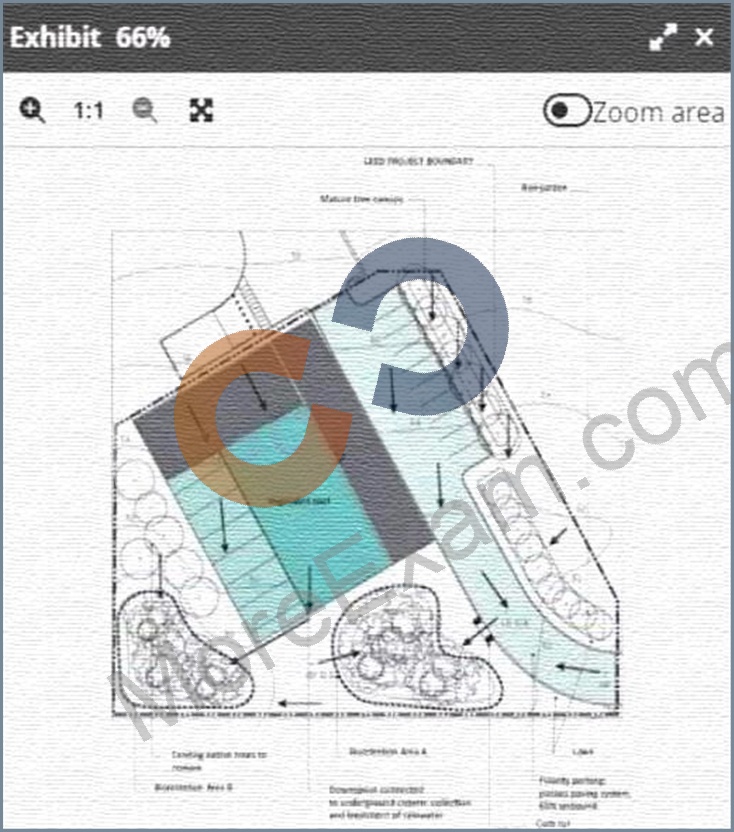
Question5: The measures called out on the following site plan may contribute to the achievement of which LEED credits?
(Click on Exhibit)
Exhibit

Question6: At a minimum, how often should a survey of building occupants be conducted about transportation patterns according to the Location and Transportation Credit, Alternative Transportation, Option 1?

Question7: In which of the following ways can a campus project using a Group Approach comply with Water Efficiency Prerequisite, Building-Level Water Metering?

Question8: Which of the following people are required to be listed on the LEED project registration page?

Question9: In densely populated rooms, CO2 monitors must be located a minimum of how many feet (meters) above the floor?

Question10: Which of the following is considered an ongoing purchase for the purpose of calculating Materials and Resources Credit, Solid Waste Management - Ongoing?

Question11: According to Indoor Environmental Quality Credit, Daylight and Quality Views, what is the view factor in the diagram below?

Question12: A LEED AP performs several on-site reviews for LEED compliance and encounters the followingscenarios.
Which scenario requires the installation of additional meters to comply with Energy and Atmosphere Prerequisite, Building-Level Energy Metering?

Question13: Which materials or products are covered in Materials and Resources Prerequisite, Facility Maintenance and Renovations Policy?

Question14: When conducting the Indoor Environmental Quality Credit, Occupant Comfort Survey what is the minimum percentage of building occupants that must respond?

Question15: How long should a commercial kitchen prep sink be metered to establish a baseline when pursuing the Water Efficiency Prerequisite, Indoor Water Use Reduction, Option 2?

Question16: Which of the following prerequisites or credits has a minimum occupancy requirement?

Question17: What is the allowed maximum tenant space exclusion for Energy and Atmosphere Prerequisite, Minimum Energy Performance?

Question18: A building owner wishes to provide better Indoor Environmental Quality to the building occupants while containing capital costs. The LEED AP suggests pursuing Indoor Environmental Quality Credit, Enhanced Indoor Air Quality Strategies, Option 2. Filtration. However, the existing HVAC system was not designed to accommodate the required filters but is otherwise efficient and operating well. Which strategy would enable credit achievement?

Question19: What must the project team do regardless of building type for Energy and Atmosphere Prerequisite, Minimum Energy Performance?

Question20: What credit rewards customers who change their normal consumption patterns in response to the varying price of energy over time?

Question21: Which of the following is the most appropriate use of untreated stormwater?

Question22: The intent of the Energy and Atmosphere Credit, Enhanced Refrigeration Management is to reduce ozone depletion and support early compliance with the

Question23: What information regarding a lamp is required to comply with Materials and Resources Credit, Purchasing - Lamps?

Question24: What credit or prerequisite requires a plan for a hazardous spill cleanup?

Question25: What public health risk must be balanced with water efficiency and chemical usage in every water treatment program?

Question26: What requirement must be met when creating a demand response program that satisfies Energy and Atmosphere Credit, Demand Response?

Question27: Which of the following LEED AP Operations and Maintenance Water Efficiency Credits has exemplary performance?

Question28: For an office building with few visitors, which of the following actions must the project team do in order to comply with Location and Transportation Credit, Alternative Transportation?

Question29: A cafeteria purchases $325.00 USD worth of United States Department of Agriculture (USDA) Organic Certified produce from a farm located 50 mi. (80 km) from the project building during the performance period.
What is the maximum allowable value for this purchase that can be claimed towards Materials and Resources Credit, Purchasing- Ongoing?

Question30: Which of the following alternative transportation strategies help reduce pollution and land development effects from automobile use?

Question31: A standard reference when creating an indoor air quality management program is

Question32: Which of the following strategies is most important for achieving economic and environmental performance in a LEED project?

Question33: In order to determine the transportation patterns of occupants of a typical office building, a survey requesting data from what period of time should be administered to meet the requirements of the Location and Transportation Credit, Alternative Transportation?

Question34: A district energy system provides chilled and hot water to a building on a campus. What equipment must be commissioned to meet the requirements of Energy and Atmosphere Credit, Existing Building Commissioning
- Analysis, Option 1. Existing Building Commissioning?

Question35: Which of the following is a low impact development (LID) technique for rainwater management?

Question36: Which of the following products qualifies under Materials and Resources Credit, Purchasing - Ongoing?

Question37: The project team of an existing urban site has 4% total vegetated area and desires to increase the percentage to equal or be greater than 5%. Which strategy can the team implement to achieve this goal?

Question38: Rainwater harvesting can be used for which of the following credits or prerequisites?

Question39: Key functional and operational parameters such as occupied hours of a building, use by space type, required temperature settings, and lighting levels, are specified in the

Question40: A building is installing outdoor light fixtures that will directly emit light into the night sky. What is the minimum lamp lumens of the fixtures that must be partially or fully shielded to achieve a point for Sustainable Sites Credit, Light Pollution Reduction?

Question41: Which of the followings operational elements need to be tracked only once during the performance period in order to meet the Sustainable Sites, Site Management Credit?

Question42: A building manager benchmarks a building's energy performance in ENERGY STAR Portfolio Manager for the purposes of Energy and Atmosphere Prerequisite, Minimum Energy Performance. The use of the energy use intensity (EUI) tool in Portfolio Manager also satisfies which of the following steps performed under Energy and Atmosphere Prerequisite, Energy Efficiency Best Management Practices?

Question43: The project team is attempting to achieve Option 1. Lighting Controls in Indoor Environmental Quality Credit, Interior Lighting. Which of the following is required documentation?

Question44: Landscape irrigation practices consume large quantities of potable water. By evaluating the project's outdoor water budget and irrigation water demand early in the Establishment Period in Water Efficiency Credit, Outdoor Water Use Reduction project teams will be able to

Question45: Which of the following topics needs to be addressed by retail project teams when administering the supply chain survey in order to meet the requirements of Materials and Resources, Ongoing Purchasing and Waste Policy, Option 1?

Question46: An ASHRAE Level 1 walkthrough analysis contributes to what prerequisite or credit?

Question47: An equipment upgrade requires an initial investment of $1,500.00 USD with a total annual savings of $500.00 and a 33% rate of return. What is the Simple Payback Period for this improvement?

Question48: The maximum number of points in the Innovation Category that can be achieved by exemplary performance is

Question49: For Materials and Resources Credit, Purchasing - Lamps, the threshold for mercury-containing lamps is

Question50: A building manager changes the sequence of operation for boilers to better match heating demand as a result of an ASHRAE Level 2 analysis. Which of the following is an example of an appropriate topic for training of building operations staff to continue implementation of this change and meet the requirements of Energy and Atmosphere Credit, Existing Building Commissioning - Implementation?

Question51: A project owner has hired a Commissioning Authority (CxA) to develop a Commissioning (Cx) Plan which will be submitted in the LEED application to document Energy and Atmosphere Credit, Existing Building Commissioning - Analysis, Option 1. Existing Building Commissioning. At a minimum, what should be included in the Cx Plan?

Question52: What information is required when adding a new space within a facility to the ENERGY STAR Portfolio Manager?

Question53: Storage locations are required for which of the following recyclable materials?

Question54: A building is certified in LEED EB v2.0. Upon recertification, which LEED Operations and Maintenance version should be used?

Question55: Which of the following is a feature of the ENERGY STAR Portfolio Manager?

Question56: How is the energy baseline determined in Minimum Energy Performance if the building type is not addressed by the ENERGY STAR rating tool?

Question57: What must the project team do in order to maximize the reduction in operational costs with regard to Sustainable Sites Credit, Site Improvement Plan?

Question58: Which of the following is a result of a low impact development rainwater management program?

Question59: What is the percentage range of total municipal waste that commercial and institutional buildings typically account for?

Question60: Which of the following is an environmentally friendly technology for controlling erosion?

Question61: The LEED AP has identified a pilot credit that is relevant to the project. This would be documented in LEED Online as a(n)

Question62: What is the maximum distance food or beverage raw materials can be harvested and produced in order to achieve the Materials and Resources Credit, Purchasing - Ongoing?

Question63: When developing a transportation survey, a LEED AP must make certain that the survey instrument collects information

Question64: Buildings account for what percentage of total energy use?

Question65: Presuming all water fixtures meet the LEED Operations and Maintenance Rating System requirements, which of the following statements is correct when considering baseline water usage in relation to water use?

Question66: A benefit of recommending LED lamps in an environmentally preferable purchasing policy is that they

Question67: A building manager has purchased and installed new T8 (fluorescent) lamps throughout the project facility.
All other lamps remained the same. The project building's average picogram per lumen hour decreased. A valid explanation for this change is that

Question68: In order for a project team to meet the requirements of Indoor Environmental Quality Credit, Integrated Pest Management, how much advanced notice to building occupants is needed after the emergency application of a pesticide other than the least toxic pesticide?

Question69: What type of Credential does the principal participant of a project need to earn in order to achieve one point in the innovation credit?

Question70: A manufacturing plant is increasing units produced and the number of employees annually. The building is documenting compliance with Energy and Atmosphere Prerequisite, Minimum Energy Performance, Case 2, Option 1. Path 2 Benchmark Against Typical Buildings Using Comparables. Which of the following should be used to normalize the building's energy use?

Question71: Under what scenario must building visitors be surveyed for the Location and Transportation Credit, Alternative Transportation, Option 1?

Question72: A management method that could be included in a project's site management policy is the use of

Question73: What is the diversion percentage of ongoing consumables in order to achieve exemplary performance as specified in Materials and Resources Credit, Solid Waste Management - Ongoing?

Question74: An urban office building project is installing a cooling tower. To save on potable water, the project would like to use a non-potable water source to provide 20% of the cooling tower makeup water to achieve the maximum number of points under Water Efficiency Credit, Cooling Tower Water Use. Which non-potable water source would be the most appropriate for use?

Question75: Innovation credits for exemplary performance are awarded for

Question76: A 1,500 ft2 (139 m2) mobile home is built in the downtown area of a major city. 90% of the project's gross floor will be completed by the time of occupancy. LEED certification is being sought. Which rating system would be the most appropriate one to use?

Question77: Which strategies allow the project to achieve maximum points under Location and Transportation Credit, Alternative Transportation?

Question78: One tenant occupying 50% of a commercial office building pursuing LEED O+M certification has provided purchasing data. The other tenants in the building occupying the remaining 50% have chosen not to provide purchasing data. For credits related to purchasing, the LEED applicant must

Question79: The compliant value of green cleaning products and materials is calculated using what factor?